Published by H&A Immigration Law Offices LLP
Racine, Wisconsin
Introduction
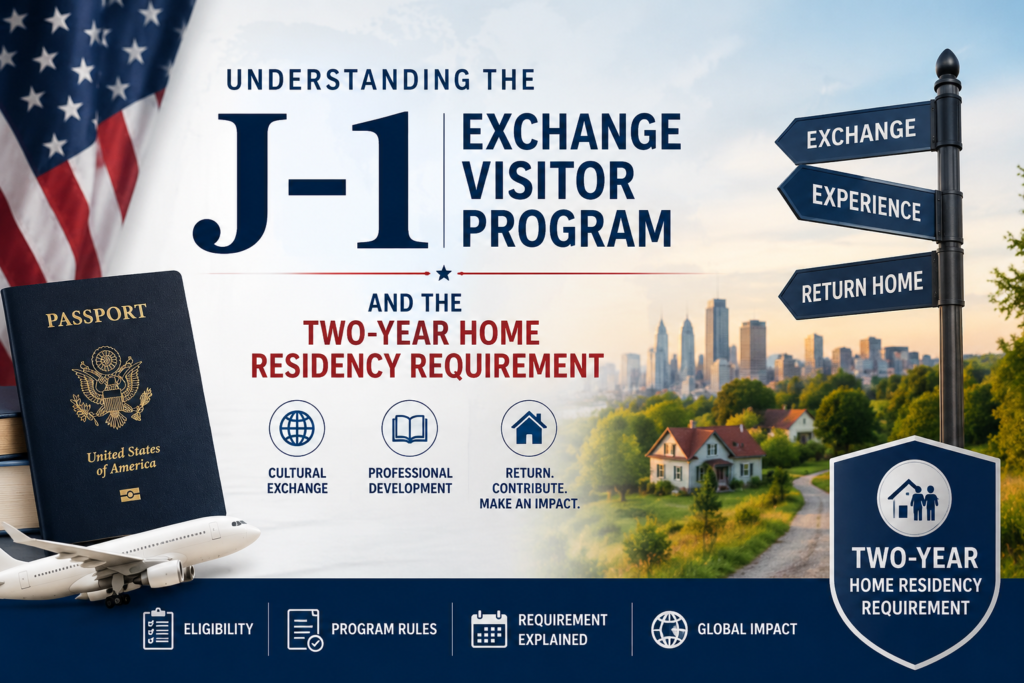
The J-1 Exchange Visitor Program allows foreign nationals to come to the United States for educational and cultural exchange opportunities. Participants may enter the U.S. to study, teach, conduct research, receive training, or gain professional experience through approved exchange programs.
The program is administered primarily by the U.S. Department of State (DOS), while U.S. Citizenship and Immigration Services (USCIS) handles certain immigration benefits, including changes of status, extensions, waivers, and employment authorization applications for eligible dependents.
Understanding the J-1 program is important because some exchange visitors may become subject to a special immigration rule known as the Two-Year Home Residency Requirement.
What Is the J-1 Exchange Visitor Program?
The J-1 visa is a nonimmigrant visa category designed to promote educational and cultural exchange between the United States and other countries.
Individuals may participate in programs such as:
- Academic studies
- Research programs
- Teaching assignments
- Training programs
- Graduate medical education
- Professional exchanges
- Cultural exchange activities
The goal of the program is to encourage international understanding and allow participants to share knowledge and experience with their home countries.
History of the J-1 Program
The exchange visitor program was first created in 1948 under the Smith-Mundt Act. Congress later expanded the program through several immigration laws, including the Immigration and Nationality Act (INA) and the Fulbright-Hayes Act.
Over time, lawmakers introduced additional requirements to ensure that participants returned to their home countries after completing their exchange programs.
What Is the Two-Year Home Residency Requirement?
Certain J-1 exchange visitors are subject to a rule known as the Two-Year Foreign Residence Requirement under Section 212(e) of the Immigration and Nationality Act.
If this requirement applies, the individual must spend a total of two years in their home country before becoming eligible for certain U.S. immigration benefits, including:
- Adjustment of Status (Green Card)
- H-1B Visa
- L-1 Visa
- Immigrant Visa Processing
The requirement may also apply to J-2 dependents.
Who Is Subject to the Two-Year Home Residency Requirement?
A J-1 participant may become subject to the requirement if:
1. Government Funding
The exchange program was funded, in whole or in part, by:
- The U.S. Government, or
- The participant’s home-country government
2. Skills List Program
The participant worked or trained in a field listed on the Exchange Visitor Skills List, which identifies occupations needed in certain countries.
3. Medical Education or Training
Foreign medical graduates who receive graduate medical education or clinical training in the United States are generally subject to the requirement.
Can the Two-Year Requirement Be Waived?
Yes. In certain situations, a waiver may be available.
Common waiver categories include:
No Objection Statement
The participant’s home-country government provides a statement indicating it has no objection to the participant remaining in the United States.
Exceptional Hardship
The applicant can demonstrate that returning home would cause exceptional hardship to a U.S. citizen or lawful permanent resident spouse or child.
Persecution
The applicant can show that returning to the home country would likely result in persecution.
Interested Government Agency Request
A U.S. government agency may request a waiver if the applicant’s continued presence serves the public interest.
Special Waiver Program for Foreign Physicians
Congress created a special waiver program known as the Conrad 30 Program.
Under this program, certain foreign physicians may receive a waiver of the two-year requirement if they:
- Agree to work in medically underserved areas;
- Obtain sponsorship from a state health department; and
- Commit to providing medical services for at least three years.
This program helps address physician shortages in rural and underserved communities throughout the United States.
What Is SEVIS?
The Student and Exchange Visitor Information System (SEVIS) is a government database used to track and monitor F-1, M-1, and J-1 nonimmigrants throughout their stay in the United States.
SEVIS helps government agencies maintain accurate information regarding:
- Program participation
- School enrollment
- Address updates
- Immigration status compliance
Today, all J-1 exchange visitors are monitored through SEVIS during their authorized stay.
Why This Matters
Many J-1 visa holders eventually wish to:
- Apply for a Green Card
- Change to H-1B status
- Pursue employment opportunities
- Remain permanently in the United States
Before taking these steps, it is important to determine whether the Two-Year Home Residency Requirement applies and whether a waiver may be available.
Failure to address this requirement can delay or prevent future immigration benefits.
How H&A Immigration Law Offices LLP Can Help
Our office assists individuals with:
- J-1 Waiver Applications
- Change of Status Requests
- Family-Based Immigration
- Employment-Based Immigration
- Green Card Applications
- H-1B Petitions
- Adjustment of Status
- Immigration Compliance Matters
If you have questions about your J-1 status or whether the Two-Year Home Residency Requirement applies to your case, contact H&A Immigration Law Offices LLP for guidance.
H&A Immigration Law Offices LLP
3018 Rapids Dr Suite A
Racine, WI 53404
Phone: (414) 982-3863
Disclaimer
This article is provided for informational purposes only and does not constitute legal advice. Immigration laws are complex and each case is unique. Consult with a qualified immigration attorney regarding your specific circumstances.