
Published by H&A Immigration Law Offices LLP
Racine, Wisconsin
Introduction
The United States provides humanitarian protection to individuals who have suffered persecution or fear future persecution in their home countries. Two of the most important forms of protection are Refugee Status and Asylum.
While both forms of relief are based on similar legal standards, the primary difference is where the individual applies for protection.
Understanding these options can help individuals and families determine what immigration relief may be available to them.
What Is a Refugee?
A refugee is a person who is located outside the United States and cannot return to their home country because of persecution or a well-founded fear of future persecution.
The persecution must be based on one or more protected grounds, including:
- Race
- Religion
- Nationality
- Political Opinion
- Membership in a Particular Social Group
Who Qualifies for Refugee Status?
To qualify as a refugee, an individual generally must:
- Meet the legal definition of a refugee under U.S. immigration law
- Be outside the United States
- Be admissible to the United States
- Not be subject to certain mandatory bars
- Be considered of special humanitarian concern to the United States
Refugees are typically screened and processed abroad before entering the United States.
What Is Asylum?
Asylum provides protection to individuals who are already physically present in the United States or who arrive at a U.S. port of entry and fear returning to their home country.
Like refugees, asylum applicants must demonstrate persecution or a well-founded fear of persecution based on:
- Race
- Religion
- Nationality
- Political Opinion
- Membership in a Particular Social Group
Who Qualifies for Asylum?
An individual may qualify for asylum if they:
- Meet the legal definition of a refugee
- Are physically present in the United States or at a U.S. port of entry
- Are not barred from asylum eligibility
- Properly file an asylum application
Most affirmative asylum applicants file Form I-589, Application for Asylum and for Withholding of Removal with USCIS.
Individuals in immigration court may also request asylum as a defense against removal proceedings.
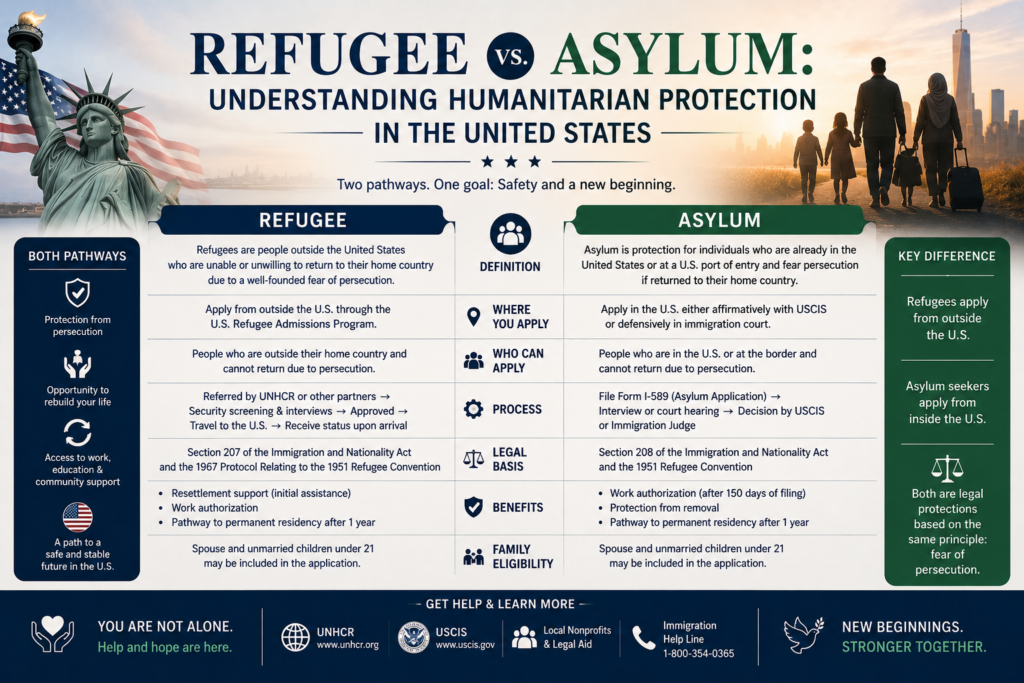
Refugee vs. Asylum: Key Differences
| Refugee | Asylum |
| Applies from outside the United States | Applies while inside the United States or at a U.S. port of entry |
| Processed before entering the U.S. | Processed after arriving in the U.S. |
| Referred through refugee programs | Filed directly with USCIS or Immigration Court |
| Must be outside the U.S. | Must be physically present in the U.S. |
Although the application process differs, both forms of protection rely on the same basic legal definition of a refugee.
Common Grounds for Asylum Claims
Examples of situations that may support an asylum claim include:
Religious Persecution
Individuals targeted because of their religious beliefs or religious practices.
Political Persecution
Individuals harmed because of their political opinions, political activities, or opposition to government policies.
Ethnic or Nationality-Based Persecution
Individuals targeted because of their ethnicity, tribal affiliation, or nationality.
Particular Social Group Claims
Individuals persecuted because they belong to a recognized social group under U.S. asylum law.
Each case is unique and must be evaluated based on the specific facts and supporting evidence.
Benefits of Asylum
Individuals granted asylum may become eligible for:
- Protection from removal
- Employment authorization
- Social Security Number
- Certain public benefits
- Derivative asylum benefits for qualifying family members
- Lawful Permanent Residence (Green Card) after one year
- U.S. Citizenship after meeting eligibility requirements
The Importance of Strong Evidence
Successful asylum cases often include evidence such as:
- Personal declarations
- Police reports
- Medical records
- News articles
- Human rights reports
- Witness statements
- Country condition evidence
Proper documentation can significantly strengthen an asylum application.
How H&A Immigration Law Offices LLP Can Help
Our office assists individuals and families with:
- Affirmative Asylum Applications
- Defensive Asylum Cases
- Refugee-Related Immigration Matters
- Employment Authorization Applications
- Family-Based Immigration
- Adjustment of Status
- Humanitarian Immigration Relief
- Immigration Court Representation
If you fear returning to your home country and would like to explore your immigration options, contact H&A Immigration Law Offices LLP for a confidential consultation.
H&A Immigration Law Offices LLP
3018 Rapids Dr Suite A
Racine, WI 53404
Phone: (414) 982-3863
Disclaimer
This article is for informational purposes only and does not constitute legal advice. Every immigration case is different. Consult with a qualified immigration attorney regarding your specific circumstances.