
Published by H&A Immigration Law Offices LLP
Racine, Wisconsin
Introduction
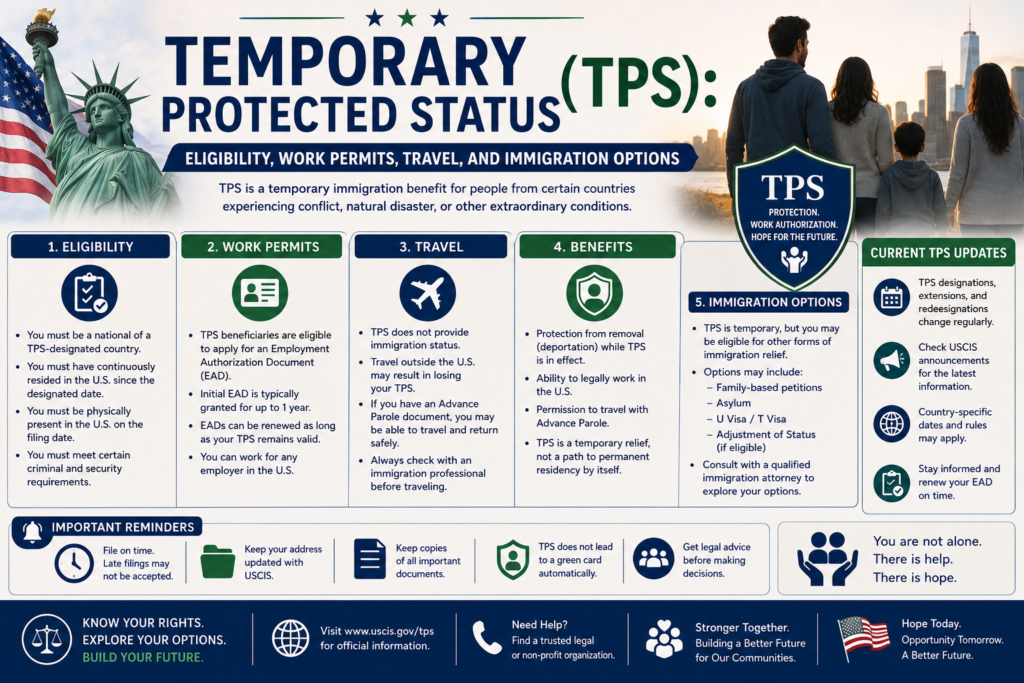
Temporary Protected Status (TPS) is a humanitarian immigration program that allows certain foreign nationals already in the United States to remain temporarily when conditions in their home countries make it unsafe to return.
TPS provides protection from removal, employment authorization, and in some cases travel authorization. While TPS offers important benefits, it is important to understand that TPS is a temporary form of protection and does not automatically lead to a Green Card or U.S. citizenship.
This guide explains TPS eligibility, application requirements, work permits, travel rules, and common questions about maintaining TPS status.
What Is Temporary Protected Status (TPS)?
TPS is a temporary immigration benefit granted by the Secretary of Homeland Security to nationals of designated countries experiencing extraordinary conditions that prevent safe return.
Countries may be designated for TPS because of:
- Ongoing armed conflict
- Civil war
- Natural disasters
- Epidemics
- Other extraordinary and temporary conditions
Individuals granted TPS may remain legally in the United States during the designated period.
Benefits of TPS
If USCIS grants TPS, beneficiaries may receive:
Protection from Removal
TPS holders generally cannot be removed from the United States based solely on their immigration status during the designated TPS period.
Employment Authorization
TPS beneficiaries may apply for an Employment Authorization Document (EAD), commonly known as a work permit.
Travel Authorization
Eligible TPS beneficiaries may request permission to travel outside the United States and return lawfully.
Protection from Immigration Detention
TPS holders generally cannot be detained solely because of their immigration status while TPS remains valid.
Important Limitation: TPS Is Not a Green Card
Many individuals mistakenly believe TPS automatically leads to permanent residency.
TPS does not:
- Provide lawful permanent resident status
- Automatically lead to a Green Card
- Automatically lead to U.S. citizenship
However, TPS recipients may still pursue other immigration benefits for which they independently qualify.
Countries Currently Designated for TPS
As of this publication, TPS designations include countries such as:
- Burma (Myanmar)
- El Salvador
- Ethiopia
- Haiti
- Lebanon
- Somalia
- South Sudan
- Sudan
- Syria
- Ukraine
- Venezuela
- Yemen
TPS designations may change based on government announcements and country conditions.
Who Is Eligible for TPS?
To qualify, an applicant generally must:
1. Be a National of a Designated Country
Applicants must be nationals of a country currently designated for TPS or individuals without nationality who last habitually resided in a designated country.
2. Meet Residence Requirements
Applicants must satisfy:
- Continuous Physical Presence (CPP) requirements
- Continuous Residence (CR) requirements
Specific dates vary depending on the country designation.
3. File During the Required Registration Period
Applicants must file during:
- Initial registration periods
- Re-registration periods
- Qualifying late registration periods
4. Meet Admissibility Requirements
Certain criminal, security, and immigration violations may affect eligibility.
Who May Not Qualify?
TPS may be denied if an applicant:
- Has a felony conviction
- Has two or more misdemeanors in the United States
- Is subject to certain security-related bars
- Participated in persecution or terrorist activities
- Fails to meet residence requirements
- Fails to properly register or re-register
Each case should be reviewed individually because exceptions and waivers may be available.
Forms Required for TPS
Form I-821
Application for Temporary Protected Status
Form I-765
Application for Employment Authorization (optional but commonly filed)
Form I-601
Application for Waiver of Grounds of Inadmissibility (if required)
Many applicants choose to file Form I-821 and Form I-765 together to avoid delays in obtaining work authorization.
Evidence Required for TPS
Applicants typically submit evidence of:
Identity and Nationality
Examples include:
- Passport
- Birth certificate
- National identity card
- Consular documents
Date of Entry
Examples include:
- Passport stamps
- Form I-94
- Immigration records
Continuous Residence
Examples include:
- Utility bills
- Lease agreements
- Employment records
- School records
- Medical records
- Church or community organization records
Biometrics Appointment
Most TPS applicants must attend a biometrics appointment.
USCIS may collect:
- Fingerprints
- Photograph
- Signature
Missing a biometrics appointment without proper rescheduling may result in denial of the application.
Employment Authorization for TPS Holders
Many TPS applicants seek work authorization through Form I-765.
Once approved, USCIS issues an Employment Authorization Document (EAD), allowing lawful employment in the United States.
TPS-related work permits may sometimes receive automatic extensions through USCIS notices or Federal Register announcements.
TPS Travel Authorization
TPS holders must obtain travel authorization before leaving the United States.
Traveling without authorization may:
- Jeopardize TPS status
- Prevent reentry into the United States
- Create immigration complications
Applicants typically request travel authorization using Form I-131.
Before traveling internationally, it is strongly recommended to consult with an immigration professional.
TPS and Asylum
TPS and asylum are separate immigration benefits.
A TPS application does not prevent someone from:
- Applying for asylum
- Applying for adjustment of status
- Seeking family-based immigration benefits
- Pursuing other humanitarian protections
In some situations, maintaining TPS may help preserve eligibility related to asylum filing deadlines.
TPS Re-Registration Requirements
TPS beneficiaries must re-register whenever USCIS announces a re-registration period for their designated country.
Failure to timely re-register may result in:
- Loss of TPS protection
- Loss of employment authorization
- Additional immigration complications
Late TPS Filing
Certain individuals may qualify for late initial filing if they meet specific requirements, including:
- Prior nonimmigrant status
- Pending immigration applications
- Pending parole requests
- Family relationships to TPS-eligible individuals
Eligibility for late filing should be evaluated carefully.
Avoid Immigration Scams
TPS applicants are frequently targeted by fraudulent immigration consultants and unauthorized practitioners.
Remember:
- USCIS forms are available directly from the government.
- Only licensed attorneys and DOJ-accredited representatives may provide legal advice.
- No one can guarantee TPS approval.
Always seek assistance from qualified immigration professionals.
How H&A Immigration Law Offices LLP Can Help
Our office assists clients with:
- TPS Applications
- TPS Re-Registration
- Employment Authorization Applications
- Travel Authorization Requests
- Waivers of Inadmissibility
- Asylum Applications
- Family-Based Immigration
- Adjustment of Status
- Humanitarian Immigration Relief
If you have questions regarding TPS eligibility, renewals, work permits, travel authorization, or alternative immigration options, contact H&A Immigration Law Offices LLP.
H&A Immigration Law Offices LLP
3018 Rapids Dr Suite A
Racine, WI 53404
Phone: (414) 982-3863
Disclaimer
This article is for informational purposes only and does not constitute legal advice. Immigration laws and TPS designations frequently change. Consult with a qualified immigration attorney regarding your specific situation.